Search This Blog

Showing posts with label lambda function. Show all posts

Sunday, 31 March 2019

Some "upgrades" weren't published, they escaped. A week of woe.


I have just come through a programming problem so frustrating, so annoying, so intractable that not only has is it taken me well over a week of shouting at the screen and hair-pulling, but also the only way to recover is the catharsis of sharing my nightmare…and a very stiff drink.

There are many lessons to be learned herein: it’s going to long, it will be very detailed and all-too-recently painful, but I think it will be worth it if you can hang on in there.

Executive summary: code and library versions can be important (and sometimes harmful!) …and “latest” is not always “best”

That nightmare started shortly after I released version 3.1 of Esparto… a couple of folk noticed problems. One in particular was using the much-more up-to-date 2.5.0 core of Arduino ESP8266 whereas all my testing, development and release had been with 2.4.2…

I felt churlish telling him it wasn’t supported, sorry -  since I am the one behind the times and really should be up-to-date myself, I always advise others to do so! I therefore set up my “upstairs” machine with Arduino IDE 1.8.8 and ESP8266 core 2.5.0. to try to a) verify the problem and b) work out a fix. 

That's when the “fun” began. Sure enough, the problem he described was happening exactly the same to me “upstairs” while all was fine downstairs…before I continue, a touch of background is necessary:

Esparto relies fundamentally on the ESPAsyncWebServer library which in turn relies upon the same author’s ESPAsyncTCP library. For good measure (well, Amazon Echo uPNP discovery, actually) is also uses ESPAsyncUDP. Note the common thread: “async”. Any / all / every piece of serious code on the ESP8266 needs to be async...or it’s just a toy, but that’s a whole other book. Back to my upstairs machine: unloved and unused for many a moon, it lacked those essential libraries, so I installed them, automatically getting the latest version – of course. The stage is now set for Act I of the tragedy.

More background: Esparto has the fancy “real-time” GPIO lights on its web UI, comme ca:


These were controlled using websockets (as was the whole of the web user interface [web UI]) and after much similar recent wrestling, had led me to insert a ton of code to limit or “throttle” the amount / rate of websocket messages going to the web UI. For example when a very “busy” GPIO might be changing state hundreds of times a second, neither the ESP8266, nor any browser, nor indeed your eyes can keep up with that so it makes sense to limit it, as failing to do so has fairly rapid and disastrous consequences, namely the ESP8266 runs out of free heap and crashes.

Lesson 1 is that if there is one key technique behind successful ESP8266 programming, it is heap management. And being async! Two. Two main techniques. But heap management it absolutely vital since the ESP8266 has so little and some libraries are very cavalier about how they use it. At core 2.3.0 I couldn’t compile the whole of Esparto since the core libraries didn’t leave enough free heap! In the early days, I also experienced “random” crashes which took me a long time to put down to sudden massive heap exhaustion (6k / 8k / 10k within seconds etc) within the ESPAsyncWebServer library, with a) no warning and b) no way to check ahead of time when the “danger zone” was imminent…

 A quick bit of “long story short” here which has ironic repercussions to follow later. About 9 months ago, I “had words” with the developer, even going as far as to provide a graph showing the exact problem once I’d spent literally weeks tracking it down…in essence there was no internal check before queuing a websocket write – neither that there was sufficient heap nor whether a large queue was building because they were coming in faster than they could be despatched…hence when either / both those things occurred* the internal queue grew out of control and used all the heap, crashing the system.

* = over 19x per second. Yep, a massive 19. Any more and the free heap drops like a rock, irrecoverably. So three pins doing 6 transitions each (e.g. flashing on/off 3x per sec) is fine. Add a fourth, and make it change more than 1x per second and you are in a terminal one-way nose dive.
The complete lack of any way to detect / prevent this led to my fairly strong words with the developer.  I ended up doing a whole ton of work to calculate this magic number, then another whole ton of work to “throttle” the GPIO and/or any other control signals to /from the webUI. Anyway, that all worked. So I carried on and released it.

Back upstairs, I am wondering how the hell only ever 8 items get added to the “run” tab dropdown box. Wiresharking the conversation, I can see I’m actually only sending 8 even though the code calls the sending function 22 times. Coincidentally I’m only sending 8 GPIO updates too even though dozens are physically occurring. Very suspicious. Another “long story short” because it actually only took me an hour or so to find the problem and my jaw dropped open in horror when I did.

The websocket lib (with which I was far too familiar due to the problems above) has changed quite a lot. At the point of socket write it effectively says

 if messageQueue.length() < MAX_QUEUE_LENGTH, add message to queue. 

That’s it. No error code if it doesn’t get queued. No fall-back and requeue. No warning message, not even at debug level! No way to discover, let alone change the hard-coded value of MAX_QUEUE_LENGTH which is…you guessed it: 8. Nope, anything more than 8 outstanding requests just get silently ignored and thrown away. I rushed to the author's webpage – no mention WHATSOEVER of any of this in the documentation. Now what goddamn use is that to man or beast?

A caveat before I continue. Those libraries are close to works of art, and I had (note past tense) nothing but admiration and respect for the author (who does a ton of other seriously clever stuff too) and Esparto couldn’t work without them. Thus it not only pains me, but I actually find it quite difficult to come out and say just quite how shitty this “fix” is. I put it down to either a) the author having had a seriously bad night on the beer before “fixing” it or b) handing it off to a far, far, inferior programmer to “do a quick fix”. It is honestly so out of character, I simply don’t understand it. It stands out like a sore thumb compared with the rest of his highly impressive code.

Irrespective, it renders that implementation of aync websockets almost totally useless for any practical purposes. 19 per sec was pretty shabby already: knocking it back to a carved-in-stone silently-discarding 8 is unforgivable. Honestly, if the author had asked me to come up with a fix myself which must be the worst possible solution on every front, I doubt if I could have managed anything so appallingly slack-arsed as what now in there. If I were paying someone as a programmer and they wiped this off their shoe, they’d now be serving coffee at Starbucks. But it doesn’t run out of heap anymore. It is the equivalent of fixing your car’s brake problems by removing the distributor cap.

So...

After the swearing had stopped (I’m lying, I still sometimes swear at the insult of it, and we are two weeks on…). I remembered that Machiavelli said we must live in the world the way it is, not the way it should be: I needed another solution, and fast.

The Solution, Part 1: Out with the old


Websockets are bi-directional and I used them to react to UI events such as clicking a button to reboot, or change tabs etc, so immediately that all had to change. To be honest the JavaScript code was a bit “lace-curtain” so I smiled through gritted teeth as I was forced to tidy it all up and make classic “ajax” calls instead. Of course, I then had to re-jig a lot of the webserver handling. While I’m doing so, I may as well do the JSON part properly…

Everything JSON I looked at was massively top-heavy, so I wrote my own JSON encoder to handle a few specific cases of sending JSON data back to the UI from std::vectors / std::maps which is how a lot of it is internally held.

After the first few days then, with an almost totally new 600-lines of ajax-compatible JavaScript , completely reworked webserver functionality, websockets ripped out root and branch and a custom JSON encoder written…phew…I was ready to stitch in the “push” side of the bidirectionality, the little-known “Server-Sent Events” or SSE. Luckily, it is already included in the ESPAsyncWebServer library. I just prayed some ******* idiot hadn’t “throttled” it to a hardcoded 8-at-a-time like they’d done to the websockets! A brief look at the code showed it appeared thankfully unfettered in that respect. Oh how much too soon I smiled…

First, the elephant in the room. Why had I been working with such an old library? Simply because there is no easy way to find out it had changed. But 9months+??? Don’t shout yet, yes I know a lot of Arduino libraries come up on that bloody annoying “some of your boards…” popup when you start the Arduino IDE…the libs I’m talking about aren’t included. Why not, you will have to ask the author. Technically, I know the reason: their metadata doesn’t match exactly the format that Arduino uses to identify libraries when it trawls github. Exactly why not, you will have to ask the author. Yes, I know that’s the second time I said it. I’m not happy with him right now. And you’re probably only just over halfway through the “fun”. I had consulted the docs dozens of times in that 9 months. Nothing on the site to show a new release available. Docs unchanged, even to the trained eye. Why would I think it needed updating? At best it would have just shifted this problem back 7-8months.

Ironically (remember that far back) when you look at what changed…much of it was obviously as a result of my graph…As the Chinese say: “Be careful what you wish for”.

The Solution, Part 2: In with the new


Very new. I’d never heard of SSE before, so a bit of reading and experimentation was needed. In reasonably short order, I had a prototype working. The basic concept was there, now to the leg-work of replacing all the “push” stuff which was mostly the GPIO pretty flashing lights, but due to heap constraints, several of the “live” tabs have to be “fed” asynchronously and piecemeal too.

Again I’m smiling through gritted teeth because I am forced unwillingly to make my code a lot better and more robust. At last, I am able to implement the “persistence of vision” optimisation that allows me to “throttle” the GPIO light to a rate that is just slightly faster than the human eye can detect…no point throwing 100 events per sec (if the interface can handle it*) at the webUi of you can only spot the difference in 24 “frames” per sec, like a movie. 

Actually it’s 23.80 – doing some simple maths will explain why – all Esparto timing is in milliseconds…and all ESPArto “maths” uses integer arithmetic. Floating point bloats the bin incredibly and it overkill for a couple of small calculations. Giving a “delay” to a timer requires telling it how many milliseconds to wait. For example, 500mS makes it run 2x per second (1000/500). Q: What it is 1000/24 ? A: 41.6666 if using floating-point, which I’m not, so it’s actually 41 from a truncated integer divide. Now 1000/41 = 24.39 per second, slightly more than I need and - if I accept that 23.809523 is close enough – which I do, then the divisor becomes 42. I need say no more. On with the show.

The plan is that when someone is viewing the UI, I will “scan” all GPIOs @ 24ish times per second and send a list of any that have changed to the JavaScript that flips them red/green. Obviously, I don’t want that overhead if no-one is watching so I have to be able to turn on off the “cinema projector” when the theatre is empty, and restart it instantly as soon as another customer arrives.

Also, I wanted – at last – to overcome the cheap’n’cheesy limit that has long existed on only one web viewer. Slight trick with that is that different tabs open for different viewers need different “live view” push data as well as the GPIO/ MQTT status etc that all active viewers need. Similarly any "watching" the same tab e.g. the graphs all need to sse the graphs updte at the same time. Managing that required a fair deal of extra code and rewrite to the webUI. Since I was having to “gut” the whole code body, I thought I may as well take this chance to get it good once and for all. All I finally need then is an easy way to detect incoming and outgoing clients.

Ah.

With a websocket you get “onConnect” and “onDisconnect” events, which make it easy. SSE is one-way only "push" technology. It doesn’t really care or stop working if it is “shouting at an empty room” so while obviously you get a “connect” message; if the client dies or goes away, you never get a "disconnect". In fact, you don't get told at all.

This is a serious pain, but not fatal, on the JS side, the EventSource reconnects automatically after a user-configurable “timeout” and provides the messageID of the last message received, so you can tell the difference between a new client (who needs the whole page) and an existing reconnect who just needs continued live push data to whatever “tab” he’s on. With some hoop-jumping and a home-brewed clientID handshake / special HTTP header in the Ajax request / configurable periodic keep-alive “ping” – I can keep track of who’s connected …and close down the hot-running cine projector when all the clients timeout (strictly, after – on average – 1.5x the “ping” time…but anyway…)

Phew. A lot of rework, and a whole new technology, but a better “product” results.

Until that is, you realise two things:

1: Haunting echoes: “…throwing 100 events per sec (if the interface can handle it*)”. Asterisk = It can’t. To be fair, it can handle a helluva lot more than 8 at a time! Due to the way I now incorporate all changed GPIOs into a single “frame” it copes reasonably well with the chosen 24ish fps. So If I have five or six pins all changing quite rapidly that’s the equivalent of – say – 120 GPIO events / sec, shifting the bottleneck now to the JS in the browser which usually can’t cope that fast…but hey: the eye can’t tell. Also, anything throwing in hundreds per sec is still only going to get sampled @ 24fps so while it may be a way removed from the physical truth, again your eye can’t tell. At least we don’t get sudden huge heap losses. Until…

2: This:


Those downward spikes? The 4kB+ sudden "you-ain’t-go-it-no-more" bites out of the free heap that happen when the client side automatically reconnects. Since there is no “on disconnect” or equivalent, it takes some time of throwing 24fps at the library before it realises the client has gone and breaks the connection. In the meanwhile, it queues up the requests into a rapidly-growing heap-chomping MCU-crashing shitstorm just like... just like those old websockets. Talk about frying pan and fire! 

A week down the line and all I have is the same problem in a whole ton of new untested code – but it’s worse, again there is no way to predict when it will occur. Nor is there any way that the library can / will tell you.

It happens when the underlying network code decides to break the connection, i.e. it’s a) too low down in the “stack” of code for me to even want to go there b) probably beyond my knowledge c) it really is pretty random. Upstairs it dies it every couple of seconds, down here it can go two minutes or more without a blink. Only two things mitigate it: 1) it is usually* less than the chunk the websockets used to grab. 2) The EventSource technology auto-reconnects “for free” – so if you can stay alive through the big chunk – albeit with a dead UI – then it pings back pretty quickly once the connection is remade. It takes 3 -5 seconds for that to happen though so the user experience is really choppy / stuttery / horrible.

*usually. It is usually 4kish but can be up to 10k in a couple of chunks and you can’t prevent it from conflicting with another request e.g. an Alexa command or a 2nd viewer using a REST call…either of which will take it further down the hill to never-land on a one-way journey to the power-recycle switch. Something has to be done.

A quick dive into the code shows that it has no checking, no low/ heap prevention – ironically it is just exactly as bad the old websocket code before the “fix”, but not yet quite as bad as the new. This time, I have to prevent the same (very low) quality of “fix” taking out my final chance if I notify the author and he “fixes” it up the same way.

I need another solution. The only thing that can be detected is a sudden loss of about 4kb heap in a very distinctive pattern. If  only I can spot that from MY side of the fence and then hit the “pause” button on the cine projector until at least most of it has come back up once the auto reconnect is complete…I might be back in business.

You are going to think my solution was a bad choice and now – more than a week later – so do I. At the time it seemed like an easy option(!): I built a” heap heuristics” module deep into the scheduler which did a variety of measurements at very high speed behind the scenes…instantaneous loss between calls, rolling average loss (cyclical buffer over last N <configurable> calls) percentage difference from a) last call b) rolling average…ultimately I ended up with 2nd differential i.e. difference between last two differences to try to narrow down the “acceleration” of the sudden 45 degree downward slope. Hmmm, really?

I spent days trying to work out where best to put the code, as the actual values vary greatly depending on where in the call stack it sits…etc. Should it run on all jobs (with a view to preventing other future problems) or just the GPIO "NetFlix" job? Even if its just on NetFlix, do I need to keep a portion running to keep the overall rolling average accurate...or do I just use the NetFlix rolling average? Is the "granularity" of last 10 measurements enough to "see" the nose-dive in time? Will I need more or will only 5 do it?  And what of the trigger values? Even though they will (of course) be configurable - I know already they wont be the same at the next version! 

The number of concurrent viewers change the trigger values. Bad network connectivity changes them. More pins change them. Every ***ing thing changes them- to the point where I could just about catch the node-dive about ¼ way down the slope, with many false positives but – fatally – the occasional false negative, i.e. a missed - and potentially fatal -“trough”. So even ofr all the configurability and complexity, it still wasn't working.

Despite the odds, I persevered through four or five days getting ever more frustrated and dispirited trying every permutation of placement, parameters, method, technique – each variant requiring major rework…I wsa paraying a certain combination would hit a "sweet spot" where I could "predict" every imminent nosedive. All the time I’m swearing and shouting “why can’t I just see the "$!%!"£$%^ing !"£$%^  message Queue length?????????????” 

Because if I could, I'd be able to see when it starts getting longer than X and immediately "back off" sending! Simples!

Not quite, because there is no way to pause to let it “drain” since the only reason it starts to accelerate in the first place is because the underlying network has already broken the link, so nothing will ever “consume” the queue contents. It took me a few days before that crushing realisation hit me. All I can do is wait until the library spots the network problem and then discards the whole queue in one fell swoop, giving that sharp upward recovery seen on the graph, which takes 3-5 seconds. During whihc time- of course - the UI is "frozen". I'm sent stuttering back to square one.

But wait…when the library does notice the network problem and “chops” the queue…as mentioned earlier, the JS notices pretty quickly and reconnects automatically. If I set that reconnection time very low (1/2 sec say) and find a way to make the lib do that cleanup sooner, by -DING! Spark of genius alert! – simply arbitrarily force-closing the connection, even while it’s still “good”…

It might all be a bit “dirty” crashing and reopening the connection all the time, but it will work. After all, upstairs with the weaker signal it is already naturally doing it a lot anyway. All I’m doing is giving nature a gentle early nudge! All I need is to get the queue length from the lib. Sounds easy.

I had been avoiding relying on someone else’s code and goodwill to accept my “fix” – but it’s the only way. How do I know? Because I put in a quite easy fix requiring only about 2 small changes and a new 6 or 7 line routine called getAvgMQL: “get average Message Queue Length”. A slight wrinkle is that the AsyncEventSource has up to n clients and it is the client that has the message Queue, so I have to average all the clients to get an overall figure. By experimentation, a queue length of 15 seems a good balance between “choppiness” and a harbinger of impending doom. Look at the following screenshot: running constantly for over 7 hrs now with a lot of pin activity and a maximum “reconnect trough” of about 2.5k That is the longest it’s been up for about 10 days.


The vertical bars are added when I do the forced close. As you can see, a couple coincide with what might be the start of a "trough". Some don’t: they are either just natural “busyness” or plain and simple false positives. Since forcing a close has very little overall effect on the smoothness, and is actually now part of the "normal" mechanism, "Frankly, my dear, I don't give a damn!"

What I do care is that the behaviour is – at last – predictable and controllable as well as being a reasonably good user experience for quite a heavy load:

Esparto.flashPattern("   ... --- ...",250,LED4);
Esparto.flashPWM(1400,10,LED5);
Esparto.flashLED(500,LED6);

D4 is toggling at a rate of 125mS or 8x per second. D8(LED4) is flashing S-O-S in morse code, i.e. … --- … on a timebase of 250ms i.e. each dot / dash is about 1/2 - 1/4 sec long sec on a continuous loop. D7(LED5) is a 10% duty cycle blip in 1.4sec period and D6 (LED6) is a simple 2x per second “square wave” so when the “peaks” line up, you are getting 12 transitions per sec from 4 different pins and the UI appears pretty responsive. Being honest, it can’t quite “do” the three short Morse blips, but now that it is stable and predictable, I can try upping the frame rate as well as well as tweaking down the Q threshold to get the optimum result.

With hindsight, If I had chosen the ”investigate / reverse engineer / fix / update” someone else’s highly complex library” route first, I’d have saved myself well over a week and a lot of hair.

Lesson 2: Don’t shy away from tough decisions if - in the long run – they are the best.

Lesson 3: Check your library versions regularly even if there is no sign they may have changed!

Lesson 4: Not all “upgrades” are good ones. For example, core 2.5.0 adds over 30k to the bin file for Esparto. Thirty K!!! It wouldn’t be so bad, but Esparto is pretty big already – in core 2.4.2 its about 430k so 2.5.0 puts that up to 450k…kinda right on the limit of what can be OTA’d into a 1MB device with the minimum SPIFFS for the webUI… Worse there is less free heap to start with, and what brought us here? Correct: low heap management - 2.5.0 just makes it worse. Right now , for me 2.5.0 is a huge retrograde step – and if that weren’t bad enough, there’s a real killer:

Esparto will simply not serve up its web page in 2.5.0 – its like it is running in glue / treacle. The exact same line-for-line code that works (now!) perfectly under 2.4.2 cannot get to first base and – for now – I’m all done with fixing other peoples’ bad upgrades. I’ll have to find a way around it a some point.

On the plus side: The web code is much more robust, and more easily expandabel if / when new features come along. The same is true of the core code and a few quite useful new features have been added:

"repeatWhile" function. Repeat function f1 every n mSec while f2 returns true and call f3after f2 returns zero to stop the repeat. This is perfect for “worker” threads “chunking up” a job in the background to conserve heap. F1 repeatedly performs a “chunk”, adjusting a counter / pointer F2 return the counter / pointer while its non-zero (still work to do) f1 keeps repeating and once all the data has been done, f3 can clean up / reset counters for next time etc. All of this is “interleaved” with other tasks, minimising heap loss and streamlining overall throughput.

Its what my "netFlix" function uses, and yes, I did call it that:

	
if(!netFlix){		
    Serial.printf("Start strobing @ %d (=%d.%dfps)\n",CII(ESPARTO_FRAME_RATE),1000/CII(ESPARTO_FRAME_RATE),((1000%CII(ESPARTO_FRAME_RATE)*100)/CII(ESPARTO_FRAME_RATE)));
    netFlix=repeatWhile([](){ return tab::nViewers(); },CII(ESPARTO_FRAME_RATE),
		[](){
		    vector<string> cp;
		    ESPARTO_CFG_MAP cPin;
		    int n=0;
		    for(int i=0;i<ESPARTO_MAX_PIN;i++){
			if(_spPins[i].dirty) cp.push_back(_light(i));					
			_spPins[i].dirty=false;				
		    }
		    if(cp.size()) _spoolBcast(jNamedArray("gpio",cp));
		},
		[](){ netFlix=0;Serial.printf("LAST PICTURE SHOW\n"); }
    ,ESPARTO_SRC_WEB,"flix");
}

While there are any UI viewers, repeat the "send changed pin" @ ESPARTO_FRAME_RATE. Oncce all viewers have gone, reset initial conditions so next viewer restarts.

Very simple but incredibly useful is vBar. It simply draws a vertical bar of a given color (default = red) across all graphs asynchronously, i.e. when you want it to happen, to show when a particular event has occurred, in context. I could not have fixed this problem without it!

Thrown in are web basic auth and the ability to change MQTT parameters through the UI and Amazon Echo v3 compatibility among several others minor changes.

Esparto v3.2 will be (code-wise) very different from v3.1 (almost a re-write!) even though it will look almost 90% the same! It will be out as soon as I’ve had a day off and got some of the new documentation(yuk) fixed up and new example code written.

Tuesday, 26 February 2019

Esparto v3 finally released!

Blimey, it's finally done. Esparto v3.0.0 released! (subject to some documentation additions and tweaks) Some fun facts:
281 files in 72 folders totalling 11.8MB
Main code is 16 source files totalling 3742 lines of code
Includes 47 example sketches totalling 3704 lines of code..I'm happy to call it 7500 lines of code...

Monday, 20 August 2018

Esparto V2 almost ready! The new web UI part 5

The lower panel(s)


Config

Now we start to see the real power of Esparto coming out. It has a configuration system where name/value pairs are automatically saved to SPIFFS (the ESP8266 Flash file system) as soon as they change and persist into the next reboot, i.e become permanent. Well, until the next factory reset, at least.

The demo code has a Latching push button on GPIO0 (Arduino digital pin D3) and a very "noisy" and sensitive  sound sensor (i.e. a high number of thousand IOs per second at the slightest cough) on GPIO12 (D6). It also configures the BUILTIN_LED for output. On a Wemos D1 mini that the demo was built on, this is on GPIO2 (D4). The hardware setup looks like this:

void setupHardware(){
  Esparto.Output(BUILTIN_LED,LOW,HIGH); // start with LED OFF                   
  Esparto.Latching(PUSHBUTTON,INPUT,10,buttonPress); // 10ms of debouncing
  Esparto.Raw(D6,INPUT,[](int s){ Serial.println("Do nothing"); });
  Esparto.throttlePin(D6,19);
}

I trust your first taste of the "esparto Way" wasn't too shocking or difficult? setupHardware() is equivalent to the standard Arduino-style setup() and you do the same kind of thing here as you would there - almost. You just do it Esparto-stylee - so for instance, no WiFi.begin and delay loops* Esparto is already connecting to your SSID "in the background" to speed things up.

Also you won't see pinMode calls: Esparto knows what mode to set automatically from the type of Esparto SmartPin you define. So really all we have is one line per I/O device, and often that's all you will need. The only "odd" or "tricky" thing is the throttlePin call. We'll get to the strange syntax in a minute, but first, what exactly is "throttling" and why do we need it here?

It is described in great detail in part 3 of this series, so if you want to know more read up on that first, but for now a simple one liner is that the sound sensors fires far more data than any tiny device can easily cope with -Esparto being no exception - so we have to slow it down, or "throttle" it. D6 is our noisy pin, so we tell Esparto only to allow through 19 of the thousands of 1s and 0s per second.

The reason this is such a low figure is explained in the earlier article. Your LED will still flash vaguely in time with your bangin' house or lounge jazz tracks...ish. Now to that weird syntax...


C++ Lambda functions:


See what? If you don't know about these already, ask Mr Google about them because you will quickly come to love them as much as I do. They are particularly good for callbacks and a lot of your code needs to be in callbacks so now is a good time to learn how to use them. If you are already frightened, fear not: you don't have to use them, the old-fashioned way still works. I will show you what that would look like in a moment and I'm sure you will soon be seeing the benefits of the new-fangled way.

What we want is for Esparto to tell us when pin D6 changes and what is has just changed to: a 0 or a 1. So we need to give Esparto a function that returns nothing (void) and takes a single int parameter, which holds the new state when the pin changed. Ordinarily we'd write:

void namedFunction(int s){
Serial.println("Do nothing");
}
and then our old-fashioned way would be:

Esparto.Raw(D6,INPUT,namedFunction);

But:
  • It's more typing
  • We have to invent a name for our free-standing "normal" function that doesn't do a whole lot
  • namedFunction can live anywhere in your code base. If your code is large and you are anything like me, it can sometimes take a while to find, by which time you forgot where it was called from!

Let's break down the "new" way (it isn't new at all, it's been around since at least 2011)

,[](int s){ Serial.println("Do nothing"); }

[] = this is a lambda function - it has no name
(int s) = same as before, it takes an int parameter called s
{ Serial.println("Do nothing"); } = this is what the function does, its body. any valid C++ code can live inside the body including if/else blocks, other lambdas etc.

Not too painful, I trust? In summary it's a function with no name (an "anonymous function") that is "bolted in" to the place that needs to call it, instead of having to live outside on its own. It has many benefits:
  • Less typing
  • Less names to remember
  • Lives alongside the thing that defined it and needs it: makes code more easy to understand and saves time hunting
  • You can do things with it that you would never have dreamt of, like pass it, lock stock and barrel as an object to another function that can then call it on your behalf! That is beyond the scope of this post, though. Ask Mr Google.
I mention these in some detail because a lot of the example code uses them, for all the reasons above, and because I love them. Esparto could not have been written without them. I hope you come to love them too, and soon - they make working with Esparto a breeze and they're not really that tough are they? Welcome to the 21st century!


Why do nothing?


The demo is purely to show the raw LED beating closely-ish in time with either some music, clapping of hands, whistling, dogs howling etc. Since Esparto does all the checking for changes and SmartPins underneath does all the flashing automatically, there is nothing else for our demo code to do. This shows how powerful Esparto is. Ordinarily the lambda is where you would put your special code that makes your app different from the rest. I do exactly that with the Latching button, which starts and stops the LED flashing by calling buttonPress which you haven't seen yet, but is here in all its glory:

void buttonPress(bool hilo){
  if(!hilo) {
    uint32_t rate=Esparto.getConfigInt("blinkrate");
    Esparto.flashLED(rate); 
  }
  else  Esparto.stopLED();
}

User-defined config variables:


And in Esparto.getConfigInt("blinkrate"); you now see the Esparto magic starting to happen. I challenge you to look at the screen shot above and guess what happens when you change the value. Go on, have a go!

If you said "I bet the LED starts flashing at the new rate automatically", you're obviously catching on but you'd be wrong. Only because I'm teasing and you haven't yet pressed the pushbutton to start it flashing at the old rate in the first place. If you had already done that then yes, exactly correct: the LED instantly starts flashing at the new rate, well done! It's now no great leap of faith to correctly assume that changing the debounce value will, er, change the debounce value of the Latching button. You are getting a whole lot of functionality for free here.

But there's more: next time you reboot, the value will be brought back - the config system saves the value whenever it changes, you have nothing further to do. The BWF parameter just made up, to play with, does nothing, isn't used anywhere and you can type what you want in there just for the fun of seeing it survive a reboot. If you want real magic, read the next section on the run panel...

Yet more: send the command testbed/flash with a payload of 1 to start and 0 to stop from an MQTT client and guess what - correct the same thing happens as if you had pressed the button physically yourself. The code to make that happen? Here:

void onMqttConnect(void){
  Serial.printf("T=%d USER SAYS MQTT CONNECTED\n",millis());
  Esparto.subscribe("flash",[](vector<string> vs){ 
    Serial.printf("Doing my thing with %s\n",CSTR(vs.back()));
    buttonPress(!atoi(CSTR(vs.back())));
    });
}

Dont worry about the "vector" stuff, that's more C++ magic that is going to make your relationship with Esparto a much more fruitful one and will be covered in the future. For now be happy that you have just avoided 3 months of tearing your hair out and a learning curve like the side of a cliff, while getting an already pretty capable system "for free" from a mere handful of lines of code!

System config variables:

Anything starting with a "~" is a system variable which Esparto relies on to function properly. So:
  1. never use "~" in your own config names
  2. while you can put whatever you like in your own variables as long as your code knows what it means, the same cannot be said for system variables
  3. never change a system variable unless you know what you are doing, and why!
Some system variables are easy to understand and make sense for the user to change. The ones I have chosen to expose for the demo are like that. By the time the full release comes round there will be a lot more, and they won't be as nice. I can safely predict that even when you read the "advanced guide" with a full explanation of what each does, you still won't want / dare / understand how to change them, so - just don't. Ever!

~fb2Ap: 

Is the millisecond count for the amount of time to wait for the WiFi to fail to connect before "falling back" to AP mode and offering yourself up to a phone, tablet etc to get in and configure a valid set of WiFi credentials. The demo has 3 minutes = 180,000 microseconds = 180 seconds. You may want less or more: feel free to change it to a sensible value that works for you.

~lh:

Is used to log the value of the heap every second to an MQTT broker, just in case the 3-minute graphs on the system page aren't enough. 1= start, 0= stop. It will publish /testbed/heap with a payload of the value once per second until you stop it, either by changing the value back to 0, publishing testbed/cmd/logheap/0 over MQTT or reading on to the next section on the run panel...

~mqXXX:

Unsurprisingly, the IP address, port and retry failure re-connection interval of your MQTT broker. Some day soon I will add ~mixer and ~mqPass to enable you to connect to an authenticating remote server. Some day...

Don't ask me about (or mess with!) the as-yet-unseen ~jitter variable - it's the plus / minus entropy timing spread adjustment factor to minimise asynchronous collision probability in the autoStats derived timer reset function. It is currently set to 10. Still fancy seeing what happens if you change it to 11? Or 243? No, I hoped not.


*Ever. No delay loops ever. They are bad, they break asynchronous libraries, stop other tasks from running and are generally BAD STYLE. Do not ever use one in an Esparto callback (or at all, in fact) you simply don't need to. If you think you do, trust me, you are wrong. There is always a better way. call Esparto.once(<x mSec delay>, functionToRunSoon); for example. Don't ever call delay(). Need I say it again?

Using C++ std library with ESP8266 Ardiuino IDE - some "gotchas" solved

The hunting of the Snark

In the latter stages of testing the forthcoming release of Esparto v2, I was "stress" testing it by throwing everything including the kitchen sink at it to see how it coped.

Short story is : it didn't. Low workloads were absolutely fine, but once the rate got above a certain figure - and I couldn't work out exactly how big - it fell in a screaming heap, which is the one thing it is designed specifically NOT to do.

Very frequently it would crash with a stack dump and it was clear that heap exhaustion was the culprit. What slowed me down was that I had spent a lot of time building in heap protection. But no matter how careful and extensive my protection was, it was failing. I searched - literally - for days, stitching in almost as much diagnostic code as there was "real" code. On a couple of occasions, I created a "heisenbug" with my diagnostics: after putting them in, the bug went away. Take them back out, it reappeared. "Aha!" I thought that's a sure-fire sign of a timing problem.

Given that the whole thing is wrapped very tightly round a microsecond-indexed custom priority_queue on the main loop which has to co-operate with asynchronous events via a mutex, it was no surprise. And I had had problems with that core module in the past. And I had made a lot of changes to it -so it was no surprise to find that that's where a lot of my "wasted" days were spent...

Ironically, it's not actually a lot of code - about 500 lines of which about 30-odd percent or more is comment and/or vertical spacing for clarity so maybe only 3-400 lines of code, but its hellishly complex - for me at least.

For a start although I have been Cing and C++ing for many a year, I only looked st the standard library about 9 months ago, as It had rapidly become clear that "functional programming" was  the only way I could get a timer to call back to a class method which was a fundamental pre-requisite for an Arduino library. Once I had got my head around lambdas and function objects and the how-did-I-ever-do-without-it bind mechanism with placeholder parameters, I was cooking! I then delved into containers and I'm now sold sold sold and wouldn't ever dream of doing things any other way. I did have to spend a lot of time with my head in Stroustrup and whining on Stack Overflow, but I got there. Mostly.

Secondly, there is the very nature of the beast: that rare area that mostly only OS designers play with more than once: task synchronisation, critical sections, interlocked atomic access, volatiles, mutexes and a slew of buzz phrases most programmers never meet in a full career...luckily I'd had some previous experience - on mainframes in the mid 1970s...Oddly enough, it was a huge help when it all came back to me. The words may be different in ESP8266land, but the tune is the same.

Thirdly I was new-ish to the ESP8266 having got into the embedded scene (as many others) with AVR-based Arduinos.

All in all, a "random" timing bug under heavy loads was all I didn't need. After days of searching and not finding, I came reluctantly to the Sherlock Holmes conclusion:

"When you have eliminated the impossible, whatever is left - no matter how improbable - must be the truth"

The truth in this case was that the reason I couldn't find the bug in my code is because - it wasn't in my code! Therefore it must be in someone else's! The prospect of digging through profoundly complex library code written by geniuses - obviously for what would be days and daysdid not fill me with deep joyOnce I had finally tracked down and nailed the problem it turned out, it wasn't actually a bug but a combination of two things, both of them on the very limits of my knowledge comfort zone. But I'm jumping ahead.

The first big clue was my voluminous diagnostics revealing a sudden and huge drop in the available heap shortly before lights-out. Every time. At least that part had a pattern. I knew though bitter sweat and very very late nights to the sound of much swearing, I could account for every byte of memory I used, every pointer RAII'd until it bled, every heap fluctuation possible - I had the spreadsheets and graphs to prove it. Yet here was a sudden massive bite out of a very small cherry while I sat with my jaw clamped shut.

We all know the ESP8266 is heap-limited. There is a ton of other code on top of my core scheduler: a web server doing dynamic updates in real-time via web sockets, a real-time pin management library, auto WiFi / MQTT connection  management with AP fallback , yada yada yada all the way up to 410k plus. The app gets out of bed with less than 30k heap to play with. By the time it tells you MQTT is waiting to hear from you, there is only 27k left in the bank.

So who or what was stealing - out of nowhere - 16k or 60% of my available space? It would be OK when I was at 27, but if the heap-thief helped itself when I had 11k spare, guess what? Oblivion. Sadly, it did exactly that quite often.

Now the implementers of the std library on this platform are obviously well aware of the ESP8266's pint pot into which they had to shoehorn a barell-full of stdlib. Something had to give. Gone is any type info, gone is the ability to get the target of a function object...I could go on, suffice to say that while it is mostly functional for my humble needs it is a (necessarily) heavily-hacked offering.

The extensive stack back trace looked like an explosion in an alphabet soup factory in Moscow. I couldn't make head nor tail once it had got below the precious few of my own routines but I persevered and finally hit pay dirt as the second of the issues became apparent to me: my lack of experience in looking "under the hood" of stl.

It's a memory problem, I know that much. I also know I can't see the problem because its not in my code, so I'm going to have put diagnostics in - gasp - the stl code. After recovering from a near-faint at the thought, I vaguely recalled a little-if-ever used feature of the custom allocator. I had glossed over it as I knew I would never be needing it. Until now, of course! If I could write a custom allocator - yes, this is how desperate I was getting - I could sprinkle it with printfs and finally nail the problem.

By jingo, that's what I started to do. I found a skeleton malloc-based proof-of-concept template on't'web and blindly cut and pasted it it, as I sure as hell couldn't understand a word of it! So it was back to Bjarne and StackOverflow and I concentrated on how this foreign beast was meant to do it magic, I never even considered the when and why...

Blinkering my vision was the fact that because I "knew" I only had a few tasks in my queue, I was concentrating on numerous other potential culprits. What I hadn't seen was that a second (yes! how odd!) bug was causing me to double- and even triple-dip at stuffing tasks into the queue. The logic simply ignored the excess and/or duplicates, so it just wasn't apparent anywhere.

I think the exact Eureka! moment came as I delved deeper into the allocator's black box that I heard myself asking "Why is the last thing just after I have added one of my meagre handful of taks to the queue?" At this point, the experienced stl'ers amongst you will have probably already seen the problem, which could even be - by some standards - classed as a "schoolboy error". Those of you who use it on big machines with unlimited virtual memory may not yet have spotted it though, because what happens on an ESP8266 never happens in your big world.

Hiding complexity is one of stl's great strengths, but it has it's dark side too, as was the case here. I knew that these magic containers would stretch to fit. What I didn't know was a) when b) by how much. What I also couldn't see was that - albeit in error - I had filled up my small queue. How small? Who knew? Only the folk who implemented the stl on the '8266. Some arbitrary default initial size that would automatically stretch to fit as and when required.Without asking. Or telling. All that nasty implementation stuff is hidden from view, which - after all - is why we use the thing in the first place isn't it?

Drifting off into the new territory of dynamic resizing, I was trying to find the place in the allocator to put the printf with current heap size at the point where my queue was allocated, so I could see how much free heap there was and what else might be stealing it But I couldn't spot where an initial allocation was made and/or a resizing allocation was made. I didn't want to waste my efforts and put it anywhere near resizing code, because my queue was so small it would never need resizing! In an idle moment I mused on what might happen in that scenario: how much bigger would it grow and where in this mess would I even start to look for that?

"Because.." I thought, musing to myself to avoid having to solve this impossible bug, "...if  it did for some bizarre reason allocate a huge chunk...".

Then it hit me like a brick: I was looking for something under the hood that not only had the potential to, but was actually grabbing a huge chunk of memory without being asked, wasn't I? I'd got so many levels nested in the complexity that I'd forgotten my call return address. Once I unwound my own mental stack, I realised I was staring the problem right in the eyes: It wasn't something else stealing the memory, it was  the queue itself!

"But why? It's tiny, look, this extra diag will show the size....!. Oh. Oh, that's a shock - where did all those tasks come from? Is there a bug in clearing the queue? Nope, checked that, works fine. is it a timing thing? Queue so busy that some underlying memory-freeing thingamajig an't get a look in?"

No, it's me accidentally busting the queue and the queue very obligingly and silently trying to expand to nicely accommodate me ...by not-so-nicely grabbing 60% of the little I have left. Bingo!

I rapidly found out how to set the capacity of the underlying vector container, hunted down the duh! bug that was tripling my queue, daringly removed (well commented out, I'm not that stupid) almost all the diagnostics, crossed my fingers, legs, arms and eyes and hit "run".

You know the rest: bug splatted. All the other code worked fine too and suddenly I'm almost ready to release. See the more recent posts here for a quick look-in - ignore the earlier posts from a few months back, it's changed a lot (because of this) since then.

On a big machine in the real world, I'd have never even noticed this. I'd have gone for release with an inefficient, heap-hungry monster. Such beasts don't live long in the mbeeded wrold, This particular one lived a lot longer than it should have, but - hey, we learn by our mistakes. Or by reading about others'!

The morals of this story are manifold:

  • Get to know a new technology in detail before playing with it in anger
  • Preallocate stl containers wherever possible
  • Where you can't preallocate, guard all accesses with heap checks
  • When you have eliminated the impossible...
  • Find the person who thinks 16k is a good size for reallocation on an '8266 and "have a word"

Anyone want to buy a brand-new completely unused custom stl memory allocator? It's an ideal self-teaching tool...

Wednesday, 8 August 2018

ESP8266 music-driven flasher in only 6 lines of code!!! (Part 1)

Firstly, I must apologise for having been away so long - I had a little medical problem. (Well, not so little...). What is little though is the number of lines you need to get a fully functional and stable ESP8266 / Arduino project off the ground using my "Esparto" library (of which more later)

Let's see it working. Second apology: I'm sorry about the distracting voiceover on the video but I discovered that Facebook recognises audio content and mutes them if it detecs copyrighted content! It's both unnerving and clever. Since I chose David Bowie's "China Girl" for the demo, I fell foul of the rule, of which - up until that point - I was blissfully unaware! I broke the system by talking loudly over it and re-uploading.


Now I guess that flashing LEDs on ESP8266s are not a new thing, but the whole point of the demo is this, which I hope is more surprising:

#include <ESPArto.h>

ESPArto Esparto;

void setupHardware(){

    Esparto.Output(LED_BUILTIN,LOW,HIGH);

    Esparto.Raw(D6,INPUT_PULLUP,[](int v){ if(v) Esparto.pulseLED(1); });

}

No, there is nothing missing: that's the whole code! And it "just works" as you can see from the videoYes, there is no setup() function and no loop() function. Esparto takes care of all of that. It manages the whole of the ESP8266 hardware (with all its complexities and traps waiting for the unwary beginner) and calls your code only when it is safe to do so. This means no more random crashes, WDT resets and other common "gotcha"s.

There's not much to explain, the pinMode does what the standard Arduino pinMode does, and a little bit more. The two extra parameters tell Esparto when the pin is "active" i.e. what binary state constitues "on" and what its inital state should be, thus saving you the digitalWrite. It defaults to LED_BUILTIN and on many dev boards it is active LOW, i.e. when you write 0 its turns on and goes off when you write 1. So here, we tell it to start "off" which is HIGH for the LED_BUILTIN on a Wemos D1, If that's confusing, I agree, but Esparto worries about all that for you. The Esparto.pinMode defaults are ...,HIGH, LOW); for "normal" LEDs so if yours is one of those just write: Esparto.pinMode(MY_LED,OUTPUT); as you would do normally, where MY_LED is set to your chosen active HIGH "normal" pin.

The next line is where the action happens - all of it. The syntax may look a) new b) odd c) horrible, and if you don't know what a C++ "lambda function is, look it up now. A good explanation can be found here. You don't need one for Esparto, the name of an ordinary function will do e.g. onPinChange - but using the lambda saves you having to write a whole extra function whose core is juist one line - in this case pulseLED.

Esparto's pulseLED does exactly what it says on the tin: it pulses or "blips" an output pin for a given number of milliseconds. In our case we choose just one millisecond which may seem as if its going to be waaay to short for our eyes to see. The sound sensor - when calibrated correctly - is going to be throwing binary 1s and 0s into pin D6 faster than you can dream of so when you "stack up" a lot of 1ms pulse into a second you get...well, you have seen the video!

So this weird "lambda" thing just calls pulseLED and because we have used the "raw" version of Esparto's many input pin types, we will get every* flicker. The pin value is passed to the lambda  (or your own function) every time it changes* in the v parameter. So we filter out only the 1s (a bit like a RISING interrupt - if you know what that is - and a forthcoming blogpost will explain why with Esparto, 99% of the time you don't need to).

If it makes you feel easier, the following does exactly the same:

 
...

void onPinChange(int v){

if(v){
  smartPins.pulseLED(1);
  }
}

...

Esparto.Raw(D6,INPUT_PULLUP,onPinChange);
...

It's just that the lambda version allows me to make the (much more) astounding claim of "...in only 6 lines"! Well worth the effort, I thought.

And that's all there is to it. If you are not impressed, then think of this:

If you change the Esparto line to: ESPArto Esparto(yourSSID.yourPWD); a number of wonderful things occur.

Firstly, you will be abe to see a webserver running on your tiny device that allows you to watch the pins flash on and off, reconfigure itself in numerous ways and even simulate receiving MQTT commands...Oh, I almsot forgot: it responds to Amazon's Alexa.

If that sounds all a little too flashy(1) then be aware you can also flash any LED with just 1 line: flashLED(1000,myPin) for example. Or flash a series of pulses in PWM style, e.g. flashLED(1000,25, myPin) will give a 250ms pulse (25% of 1000) every 1sec (1000ms). Enough? What about flashing a repetetive pattern such as S-O-S in morse code? Yes, you guessed it: flashLED("... --- ...",myPin). You can even have many LEDs all flashing at different rates, patterns etc without any problems and with only a few lines of code.

If a raw pin is no use to you, choose from:
  • Debounced
  • Encoder
  • EncoderAuto
  • Latching
  • Polled
  • Reporting
  • Retriggering
  • Timed
- all done for you. But wait! There's a full Esparto v2.0 preview coming soon, you can read all about it then. Esparto v2.0 is "in the works" and will be released soon, so until then get youself one of these:

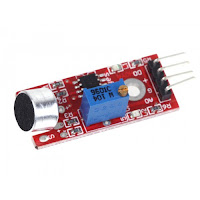
Cheapie sound sensor for ESP8266


One important point to note is to power it from the 3.3v rail. NOT the 5v! Connect the lead labelled DO (Digital Output) to your chosen pin on your ESP8266, nodeMCU etc - Esparto works on pretty much any dev board with an ESP-12 module on it. The demo uses a Wemos (now LOLIN) D1 mini and I chose GPIO12 which is Arduino digital D6 and turn the music up LOUD! Seriously, those cheap sensors are not very sensitive and you will need to be very close to the speaker. Also, you will have to calibrate the sensor by twiddling the tiny trimpot until it is just on the edge of going wild...then sit back and enjoy.

In part 2, we will look at a slightly more advanced version that a) uses a different technique from Esparto's built-in pulseLED function and b) uses a rotary encoder to "tweak" the LED response for a much more subtle and pleasing effect. Don't worry, as you may expect by now, its only a few extra lines. 

*as long as it happens no less than 120 microseconds after the previous one...a forthcoming article will explain this and why using notoriously tricky interrupts may well be a thing of the past since Esparto


Wednesday, 1 November 2017

Event-driven programming with callbacks

The previous article (which you should read now, before you continue) how "callbacks" made programming the ESP8266 easier and less error-prone - but what do they look like and how do they work?

Let's take the case where you want to read a sensor every minute. I've seen a lot of code like this around (or variations of it)

#define SENSOR 5

void setup(){
  Serial.begin(74880);
  pinMode(SENSOR,INPUT);

}

void loop(){
  if (millis()%60000){
    Serial.println("do something");
  }
}
Looks OK? Often the if(millis()... will be taking the current time, subtracting the previous value and checking if it == 1000 which of course requires a global variable for the previous value and some extra code, but the principle is the same - and it doesn't work!

loop() gets called about 40,000 times a second. So you are likely to "do something" up to 40 times because the value of millis() will be the same until another millisecond elapses! So, depending on how long "do something" takes, depends on how often it will be called, which is nothing like what you think you were doing, and if "do something" relies on accurate timing, your program will not work.

"Easy!" you think, "I'll set another global variable while doing something, then check it in loop and make sure I only do something once per loop".

"or, I can put delay(60000) inside the loop and then my timing will be accurate!"

The first option adds more code, more complexity (none of which is necessary and usually frowned upon - for plenty of good reasons - by experienced programmers) and the second just won't work.

No, the solution is to use the Ticker library which runs a highly accurate timer and calls back your code when the timer expires:

#include<Ticker.h>
#define SENSOR 5

Ticker  everyMinute; 

void doSomething(){                        // this is your callback function
  Serial.println("do something");
}

void setup(){
  Serial.begin(74880);
  pinMode(SENSOR,INPUT);
  everyMinute.attach_ms(60000,doSomething); // "register" your callback
}

void loop(){
}

The most important thing to realise here is that doSomething does not get called by everyMinute.attach_ms(60000,doSomething) in setup...all you are doing here is telling the Ticker library the name of your function - "registering" it - which will then be called every minute.

In a nutshell, that's how callbacks work. They are lot simpler, a lot cleaner and prevent you from re-inventing the wheel every time you write a sketch. But the most important  thing, is that they "just work" and they avoid numerous common problems.

Imagine if you had three or four sensors which need reading at different times...the loop code would very soon start to get complicated...using Ticker, you just have three or four tickers going off at different times, each with its own separate (obvious) callback which does just what that sensor needs. It's a lot more obvious and easier to read as well as being a lot less error-prone.

If you use "lambda" functions (and if you don't, you should - google them now) it's  even easier:

#include<Ticker.h>
#define SENSOR 5

Ticker  everyMinute;  

void setup(){
  Serial.begin(74880);
  pinMode(SENSOR,INPUT);
  everyMinute.attach_ms(60000,[](){ Serial.println("do something"); });
}

void loop(){
}

The "callback" is defined "inline" with the thing that will call it and saves having a separately defined function.

The Ticker library also allows you to pass a single (32-bit) parameter to your callback function, which is extremely useful and solves a lot of additional issues in the majority of cases. If however you want to pass two parameters, or call a class method when the timer "fires" - you are in for a lot of "fun" - unless you look at the author's "H4" library github.com/philbowles/h4 which is specifically designed to do just those things. It also adds more creative timer functions, such as calling back at random times or calling back a fixed number of times. Finally, it allows you to "chain" functions, i.e. call one after another has just finished. This allows some quite complex sequences to be built in to your code very simply indeed.

If the H4 library is used correctly, you will never need to call delay()...nor will ever need to know (far less need to muck about with) the "watchdog timer" and if you don't yet know why those are good things, read the next two articles!

It also does something much more important to prevent common errors, but I'll explain that later, once you are more familiar with this new "event-driven" style.